Freshify · First-Class Service Architecture
Your software has a
structural problem
Most logistics and commerce software is built on a single-company hierarchy — and it quietly kills your ability to scale. Freshify redesigns the architecture before the cracks become rebuilds.
Watch How We Do It
→
Book a Discovery Call
The Diagnosis
Most software failures aren't bugs. They're structural. The longer you build on a broken architecture, the more expensive it becomes to fix — or replace.
Schema Lock
Permission Collapse
Rebuild Failure
The Architecture
We don't rebuild your software. We redesign the layer underneath it — the modules, the interfaces, and the permission architecture that make multi-tenant scale possible. The result is a codebase where services are sovereign, interfaces are standard, and enterprise clients can be onboarded without touching your core schema.
◆
Pillar 01
Service-Ready Modules
Not microservices. Not a monolith. Each service module owns its data, exposes a standard interface, and can be deployed independently — without collapsing the system around it.
◆
Pillar 02
Service Module Discovery
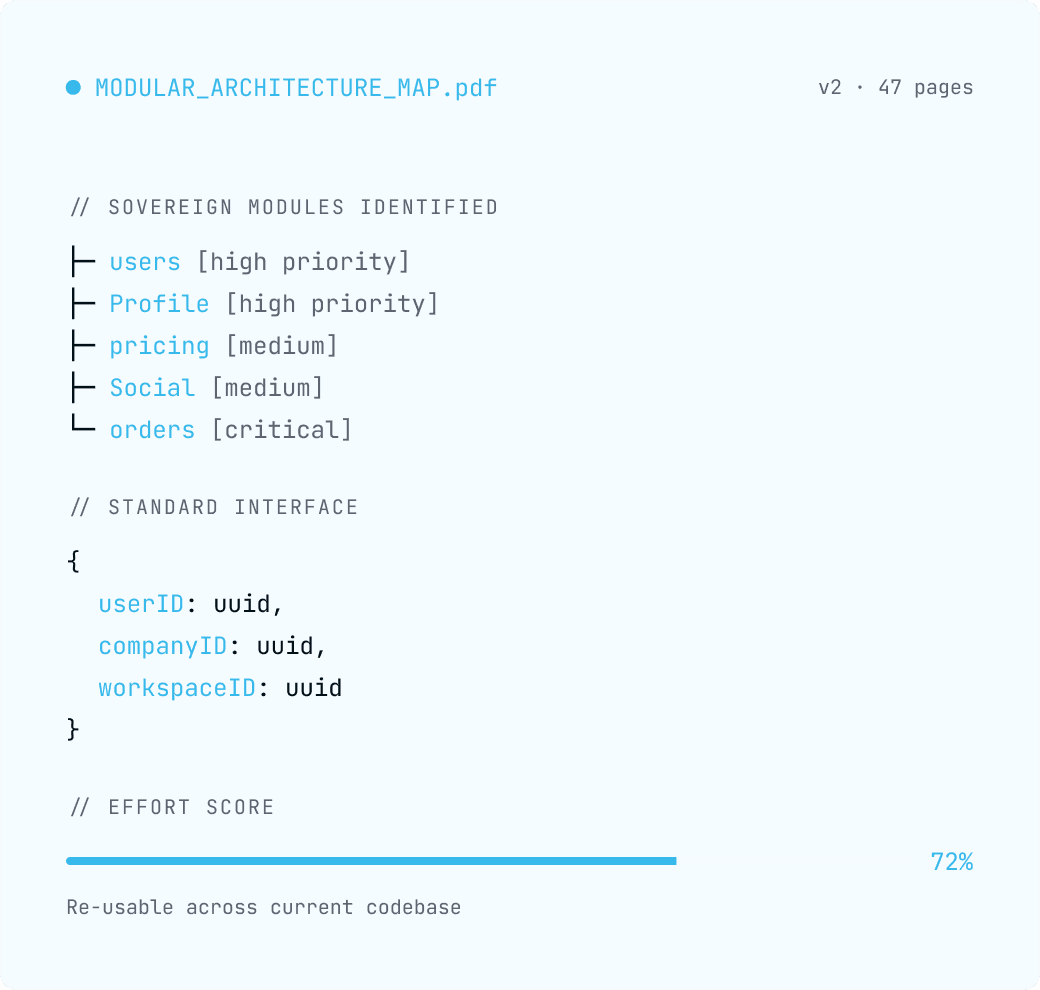
Our named 6-phase diagnostic process. We map your existing schema, identify sovereign module candidates, and produce a Modular Architecture Map — your blueprint before a single line changes.
◆
Pillar 03
Standard Module Interface
Every module in a First-Class Service Architecture communicates identically: UserID, CompanyID, WorkspaceID. No custom handshakes. No one-off integrations. No permission spaghetti.
Three Phases. One Architecture.
Every engagement follows the same sequence — from diagnostic to design to development — so you always know where you are and what comes next.
◆ Start Here
Modular Architecture Map
$2K – $5K · the entry point
Get your map before committing to a full engagement. The Map gives you a sovereign module list, architecture diagram, permission spec, and a gap summary with effort scoring — enough to decide whether to proceed, hand it to an internal team, or bring us back for Phase 2.
Get Your Map
→
Who We Serve
Logistics and commerce software share the same structural flaw: a company-centric hierarchy that assumes one client, one schema, one set of rules. We've designed the fix for both.
Logistics Software
Multi-depot operations, carrier networks, and enterprise shippers all demand different pricing, routing, and access rules — none of which a single-company schema can support cleanly. We restructure the service layer so each operational domain is sovereign and independently configurable.
Depots
Carriers
Routing
Pricing Sets
Shippers
Commerce Software
Multi-brand, multi-region, and marketplace commerce platforms collapse when product catalogues, pricing sets, and order workflows are locked to a single tenant record. We separate those concerns into modules that can serve any merchant configuration without schema changes.
Catalogues
Multi-brand
Marketplace
Order Sets
Regions
The Deliverable
The Map is the output of our Service Module Discovery process — a structured
deliverable that shows you exactly what your software should look like before you
commit to building it. It exists because the most expensive mistake in software is starting development before architecture is resolved.
Entry Point Engagement
$2K - $5K
Get Your Map
→
· Process Video
See exactly how we do it.
The process video walks through a real Service Module Discovery engagement — from initial schema review to the final Modular Architecture Map. You'll see the 6 phases in action, the decisions we make at each step, and what the deliverable looks like before we hand it to your team.
No sales call. Just the process.
Case Study
Company Context
Logistics software built on a single company record.
RAS Logistics operates a logistics software platform built on a company-centric hierarchy. All user records, locations, pricing, and orders were tied to a single company record — a structure that made configuration fast for small customers and impossible for large ones.
The Problem
At 50 accounts, the architecture started to give.
Users, locations, and pricing sets couldn't be scoped below the company level. Enterprise clients who needed separate access per team, per depot, or per contract couldn't be served without manual workarounds. Every new large client required custom configuration that no one else could re-use.
What We Designed
Five sovereign modules. One standard interface.
Using the Service Module Discovery process, we identified 5 sovereign modules — Users, Locations, Pricing Sets, Order Sets, and Orders — each with a clearly defined data boundary and a standard interface. No shared tables. No inherited roles. Each module independently configurable per workspace.
Projected Outcome
60%+
Projected reduction in configuration duplication across client onboarding.
Multi-tenant scaling unlocked: enterprise clients can now be scoped at workspace level without modifying the core schema. The architecture supports 500+ clients using the same codebase.
Architecture before code.
Modules before scale.
Watch How We Do It
Book a Discovery Call
© 2026 · All rights reserved